#1 – Who was John Giorno?
"I wanted to do more than write poems. I wanted to broaden the ways that poets could connect with audiences. The poet should use modern technology and invent new methods for making and communicating their work. There were boundless ways for poets to make art. Anything and everything was possible."
John Giorno
New York native John Giorno (1936–2019) was a poet, visual artist, peace activist, gay rights advocate, devoted hedonist, ardent lover, and committed Buddhist—in short, a man who moved through life with his eyes and heart wide open. He turned to writing after reading works by members of the Beat Generation. But it was his immersion in the Pop art scene that convinced him to make poetry his life’s work. He set out to rethink what the art form could be: something more accessible, entertaining, rooted in everyday experience.
Giorno grounded his work in the social transformations of his time—technology, communication systems, and the rise of advertising—embracing “found” poetry alongside visual, sound, performance and written forms. He conceived of poetry as a fully fledged “system”: one he applied across every aspect of his life.
This MAMCO exhibition, part of the museum’s off-site program, introduces Giorno through his life and work. It also contextualizes Dial-A-Poem (1969)—Giorno’s poetry hotline—presented here in a Swiss version that visitors can dial into on their own phones or listen to in the booth next to the rotunda.
Curated by Elisabeth Jobin and Charlotte Morel in collaboration with the Bains des Pâquis exhibition team and with the support of the Jan Michalski Foundation, Pro Helvetia, and the Oertli Foundation.
#2 – A Literary Shockwave
"In the bleak cultural years of the 1950s, Kerouac and Ginsberg were the only living voices of truth, shining angels who touched my heart, the only ones who showed there was the possibility of change, and a clear perception of reality."
John Giorno
The early 1950s marked a dramatic turning point in US literature propelled by the Beat Generation, a group of young writers so named because they conceived of themselves as being “beaten down” or downtrodden. Its members, reacting to the conformist society they inhabited, structured their writing around lived experience and patterns of speech.
Captivated by the underworld—by crime, drugs, and lives lived outside the confines of bourgeois respectability—they developed a rhythmic form of poetry bound up with their own bohemian lives: often nomadic, and closely tied to the street.
The movement coalesced around three leading figures and their landmark works: Howl by Allen Ginsberg, On the Road by Jack Kerouac, and Naked Lunch by William S. Burroughs. In literary terms, these three books were nothing short of seismic events, provoking the wrath of censors. They laid bare a radical intensity of feeling, captured in Kerouac’s famous line: “The only people for me are the mad ones ... the ones who burn, burn, burn.” Reading their work was Giorno’s entry point into poetry. And he would go on to meet each of them in person.
#3 – The New York Underground
"I was fifteen when I first came into contact with poetry. But it was in 1962 that I really began, using found images. … When I saw the artists around me, Robert Rauschenberg or Jasper Johns, using “found images,” each in their own way, I thought that if they could do it in painting, I could do it in poetry."
John Giorno
Early-1960s New York was the epicenter of a vibrant underground scene. Artists, writers and musicians experimented with new creative methods, collaborating, improvising, and embracing chance and transience. Operating outside established institutions, they formed informal, multidisciplinary networks centered around creative and performance spaces.
Based in New York, Giorno was introduced to the city’s counterculture scene by Andy Warhol, for whom he briefly served as a muse. Giorno soon established himself as a central figure, building close ties with leading members of the Beat Generation and avant-garde artists—interactions that would influence his development as a poet. Giorno took the visual-arts principle of the “found image” and applied it to writing, forging from the outset a hybrid form of poetry set in dialogue with other art forms and shaped by the cultural intensity of New York.
#4 – Poetry and Revolt
"For eight months, we had talked endlessly about what I believed was the somewhat enlightened times in which we lived – the change, freedoms, and individual liberations that had occurred in the culture from civil rights in the 1950s and ’60s, protesting the Vietnam War, gay rights and feminism, psychedelic and mind-expanding drugs, and meditation."
John Giorno
In the 1960s, young Americans openly rejected a social order built on traditional values, capitalism, consumer culture, war—most visibly in Vietnam—and the comforts of middle-class life. Woodstock, the festival held in 1969 in upstate New York, served as a rallying point for those dreaming of a different kind of society. The ideal that event embodied was communal and collective, founded on principles of sharing and personal freedom.
It was a time when many people—eager to break free from Western cultural norms and broaden their horizons—chose to experiment with new ways of living, making art and experiencing the world. They formed communities where they could live differently and enjoy freer, more authentic, non-possessive relationships. The movement left a lasting cultural imprint, particularly in music and the arts.
Giorno’s work and activism emerged from this rebellious climate. He saw poetry as something inseparable from its time, whose purpose was to capture contemporary change and help free people’s minds.
#5 – Art in the Street
"To say a poem is to turn it into something else. … I rehearse my poems all the time, every day. I rehearse them so much that the poem becomes something new, something else. You move beyond poetry."
John Giorno
By the 1950s—and unmistakably in the 1970s—performance had claimed its place as an art form in its own right, driven in part by the emergence of Conceptual art. Figures like Allan Kaprow and Vito Acconci took art out of studios and galleries and into the city itself, turning the street into a testing ground for ephemeral interventions, rule-based walks and chance encounters with passersby. The line between art and everyday life blurred.
It was at this point that poetry took on a new form—one that relied on movement, on the body, on presence. In the United States, John Giorno forged his own, distinctive version of performance poetry. For his Street Works performances, he brought poems out of institutions and into the open, stopping people on the street and putting the words directly into their hands.
Giorno also performed on stage. Starting in 1965, he began writing poems to be read aloud, recorded and broadcast. His intense, often theatrical performances centered on speaking, repetition and directly addressing the audience.
#6 – Seeing the Letter
"I worked on the poem with absolute concentration, choosing images that joined one another in a magical display, made line breaks, wove the threads of the nonlinear narrative, created repetitions by doubling and tripling the lines for depth of meaning and musical force, trying as hard as I could to make it perfect."
John Giorno
In the 1950s, poets in Europe, Japan, Brazil, and North America began to work at the intersection of art and literature. This new form, known as visual or “concrete” poetry, emphasized words as things to be looked at, not merely read. These poets appreciated the visual and spatial aspects of letters: where they sat on the page, their shape and their materiality. Words were detached from grammar, and even from meaning and linear readability. Instead, each poem—whether in a book, on a typed sheet, or in the form of a collage or folded page—became an object with its own artistic value.
This strand of experimental poetry found a stronger foothold in Europe than in the United States. In the 1980s, while in France, Giorno befriended Bernard Heidsieck and Françoise Janicot, who introduced him to sound poetry. A few years later, he began making painted works in acrylic, executing lines of verse across the surface in block letters. These works fused visual poetry with the spirit of Pop art, the US movement that drew on the punchy slogans and bright colors typical of advertising.
#7 – The Sound of Words
"Brion opened me up to sound poetry, or poésie sonore, and we collaborated making sound pieces of several of my poems. One was based on a poem called “Subway,” which I had taken from ads posted inside trains. Brion loved it and we went underground to record him reading the poem, as well as the echoes and rumbles of the underground."
John Giorno
The 1950s witnessed the emergence not only of visual poetry but also of sound poetry, a form in which poems moved from the printed page to performance. The text was read aloud or spoken, rhythmically, before a live audience or in a recording studio. It is inseparable from voice and body.
In France, several poets—including François Dufrêne, Pierre Garnier, and, above all, Henri Chopin—pushed this form forward, including in theoretical writings. Between 1958 and 1974, Chopin published OU – Cinquième saison, a periodical in vinyl-record format featuring sound works by various US poets including Giorno, who appeared in a 1965 issue.
Sound poets sought to transform the act of consuming poetry from a solitary, bookish pursuit to an exercise that engaged the ear. They broke language down into phonemes—the smallest units of sound, each with its own musical qualities. And advances in recording technology allowed these poets to layer the spoken word with experimental sound and music.
#8 – Writing Under the Influence
"Around four in the afternoon, I settled in to work on a new poem. I took half a Dexedrine and, while waiting for it to hit, smoked joints and cigarettes, and drank vodka and soda, which was a chemical combination that went extremely well with my work … I was pragmatic; anything was worth a great poem."
John Giorno
Like French writer Henri Michaux, many Western artists and authors used hashish, mescaline and other hallucinogenic substances to tap into their subconscious. They strove to bypass the dividing line between body and language to produce automatic, uninhibited output. They believed that writing, painting and music were not separate disciplines, but rather that they sprung from the same primal source.
These artists treated writing under the influence as a tool. For them, hallucinogens—like the practice of repetition or chanting—were meant to induce a contemplative, at times hypnotic state, much like the experimental music being produced at the time.
Giorno’s work belongs, in part, to this tradition. Like many of his peers, he experimented with drugs as a way of unlocking his creativity, seeking to tie the act of writing to lived experience, the body and altered states of consciousness.
#9 – Repetitive Music and Meditation
"William Burroughs and Brion Gysin influenced me a lot when I wanted to mix art and technology, especially when they introduced me to sound poetry. … Then I took inspiration from loops that Max Neuhaus and Steve Reich were developing. Again, I thought I could do the same thing with my words. I didn’t really look out for technology, it came to me."
John Giorno
In the postwar years, US artists took a renewed interest in French composer Erik Satie, a modernist whose work, known for its pared-back, repetitive style, blurred the line between music and performance. John Cage carried Satie’s legacy forward, especially with his compositions for prepared piano. American composers Steve Reich, Philip Glass, and Terry Riley were also inspired by Satie.
The use of loops—short, repeated sections of sound material—produced a contemplative, even hypnotic effect and would go on to influence both contemporary and pop music in lasting ways. Giorno was an early adopter of this fluid, cross-disciplinary approach, using new technologies to bring his poetry to life.
A darker urban counterculture emerged in the New York of the late 1960s and early 1970s, as rock musicians, poets and avant-garde artists coalesced around figureheads such as Andy Warhol and The Velvet Underground. The scene found its focal point in 1973 with the opening of CBGB, the New York punk club that became a popular destination for musicians, writers and poets alike.
#10 – The Pull of Buddhism
"I went to India to find the empty nature of mind. I had had enough of being a victim of my own mind. I knew there was a way out, a release from delusion and suffering. Everyone was a Buddha. From psychedelic mushrooms and LSD, I was aware that there were many other realms of existence, of which I knew nothing."
John Giorno
As hippie culture spread across the United States and interest in Eastern spirituality grew, many artists and writers embarked on formative journeys to India and Nepal. They sought alternative worldviews and philosophies that emphasized self-knowledge, meditation and the acceptance of impermanence—the notion that everything changes and nothing lasts.
Giorno, seeking to free his mind, was among those who embarked on this inner journey of self-discovery. He was first introduced to Buddhism through the spiritual explorations of his friend, the writer Allen Ginsberg. In 1971, Giorno traveled to Sarnath in India, where he met the lama Dudjom Rinpoche and became his student.
Giorno regularly returned for stays and retreats in Tibetan monasteries, and Buddhism and meditation remained a major influence on the rest of his life, guiding him toward empathy, compassion and love. In the 1980s, his loft at 222 Bowery became a place for New York’s Tibetan community to meet and hold rituals.
#11 – Pop Art
"But in the early 1960s, hanging out with my artist friends, it was clear that poetry was seventy-five years behind painting, sculpture, music, and dance. The golden age of poetry was just about to begin."
John Giorno
The Pop art movement first emerged in postwar Britain before taking hold in the United States, where consumer culture and mass media were transforming society. Advertising, the press, television and slogans became artists’ raw material, as Pop figures like Andy Warhol, Robert Rauschenberg, Jasper Johns, and Roy Lichtenstein challenged established thinking about originality, reproduction and the power of images.
In 1960s New York, Pop art spilled beyond the visual arts, shaping a wider culture of experimentation between art forms. Poetry was no exception: Giorno took the methods employed by Pop artists—with whom he was close—and applied them to language.
Giorno’s visual poems, which read like slogans or mantras, extended Pop art’s drive to take art off its pedestal: he treated words like images, detaching them from the page and releasing them into the public sphere, turning poetry into something direct, open to all and grounded in the present.
#12 – Writing a Poem with a Pair of Scissors
"Next, William played a cut-up experiment on the cassette recorder. … This one was made from sound tapes of a Piper Cub airplane crash on Jones Beach, official dispatches from the American armed forces in Vietnam, a book he was writing … and a cops-and-robbers caper. The tape was rough, barely audible, boring, and went on forever. But it was astonishing and beyond concepts. It was a heroic new way of seeing the nature of reality."
John Giorno
Collage is a method used by painters since the Dada and Surrealist movements of the first half of the 20th century, but it wasn’t until the late 1950s that writers embraced the technique. Its best-known advocates, American authors Brion Gysin and William S. Burroughs—both friends of Giorno—would go on to call it “cut-up.”
Their approach was simple: take found texts, cut lines from them with a pair of scissors, and rearrange them to create a new poem, signed by the person who assembled it. “Cut-ups belong to everyone,” Burroughs wrote, arguing that poetry should be something anyone could do, without the need for original thinking, inspiration or formal training. All it took was a pair of scissors and a willingness to embrace chance and the unexpected.
Giorno was a key exponent of found poetry: works in which existing chunks of text were rearranged to produce new meaning, much like the principle behind “readymades” in art.
#13 – Experiments in Art and Technology (E.A.T.)
"The Moog synthesizer was analog, not digital. Bob plugged in patch cords, turned knobs, and experimented, sending the voice through oscillators, filters, and amplifiers. The musical qualities inherent in the words, the onomatopoeia, was enhanced naturally and magnified musically with buzzes, swoops, whooshes, scrapes, gurgles, screeches, burps, and cackles. … [T]he tracks came together in miraculous symphonies of song."
John Giorno
The 1960s sparked a new age of rapid advances in audiovisual and communication technology and the arrival of new mediums of artistic expression. In 1966, this spirit of optimism led Billy Klüver to found Experiments in Art and Technology (E.A.T.), an organization that sought to link pioneering creative work with new technology.
E.A.T. connected figures from the visual arts, music, dance and performance with engineers, who together produced installations and live shows featuring audio and video recordings. These collaborative works were first shown at 9 Evenings: Theater & Engineering, a series of performances in New York in 1966 attended by more than 10,000 people.
Giorno, for his part, teamed up with engineer Robert Moog, the inventor of the synthesizer, to design a keyboard that could generate both sounds and words across multiple tracks. He also worked with Fred Waldhauser to create an organ that transformed sound into beams of light.
#14 – The Medium is the Message
"With Dial-A-Poem we transcended Marshall McLuhan’s “The medium is the message.” We were the medium and the message. And the real message was wisdom sound. Over the next years, Dial-A-Poem would usher in a new era of telecommunications, bringing poetry to millions of people."
John Giorno
“The medium is the message” is a phrase coined in 1964 by Canadian communication theorist Marshall McLuhan to refer to the notion that the way a message is delivered—its format, the technology used, its visual impact—matters more than what it says. The concept emerged alongside the rapid growth of mass media, a development made possible by television, radio, telephones, the press and advertising.
This idea was soon seized on by artists, especially members of the Pop art movement, who began incorporating images from everyday life, advertising and popular visual culture into their work.
Giorno, who was immersed in this avant-garde scene, set out to make poetry more plainspoken and accessible, placing the question of circulation—how to bring the genre to a much wider audience—at the center of his practice. He took lines of verse out of the book and into other formats that offered more audience touchpoints: the telephone, vinyl records, performances, live readings and paintings.
#15 – The AIDS Epidemic
"To receive and raise money for my poetry projects and events, I needed to create a not-for-profit organization, and that organization needed a name. So I took something commercial and industrial and gave it a wry metaphoric spin: Giorno Poetry Systems."
John Giorno
In the 1980s, AIDS hit New York’s counterculture scene hard. Artists, writers and musicians died in large numbers, while the community faced stigma and received scant support from the authorities. In response, artists and activists mobilized to raise awareness, including through a series of exhibitions. One such show was Witnesses: Against Our Vanishing, curated by Nan Goldin and held at New York’s Artists Space in 1990.
Although Giorno never contracted HIV, he was deeply affected by the epidemic. In 1984—a time when the disease was still widely referred to as “gay cancer”—he established the AIDS Treatment Project through his nonprofit Giorno Poetry Systems. It provided financial, emotional and practical support to people living with AIDS via a network of volunteers. Benefit concerts were also held, promoting the values of unconditional love and compassion that were central to Giorno’s artistic practice.
#16 – A New Poetry Hotline
"It was a joy for me, choosing which poets and poems, thinking about how they related to one another, what bigger story they told. They presented a full display of all the emotions, anger, desire, and ignorance – something for everybody. People called many times, to see what else was on. If they didn’t like the poet, they hung up and dialed again."
John Giorno
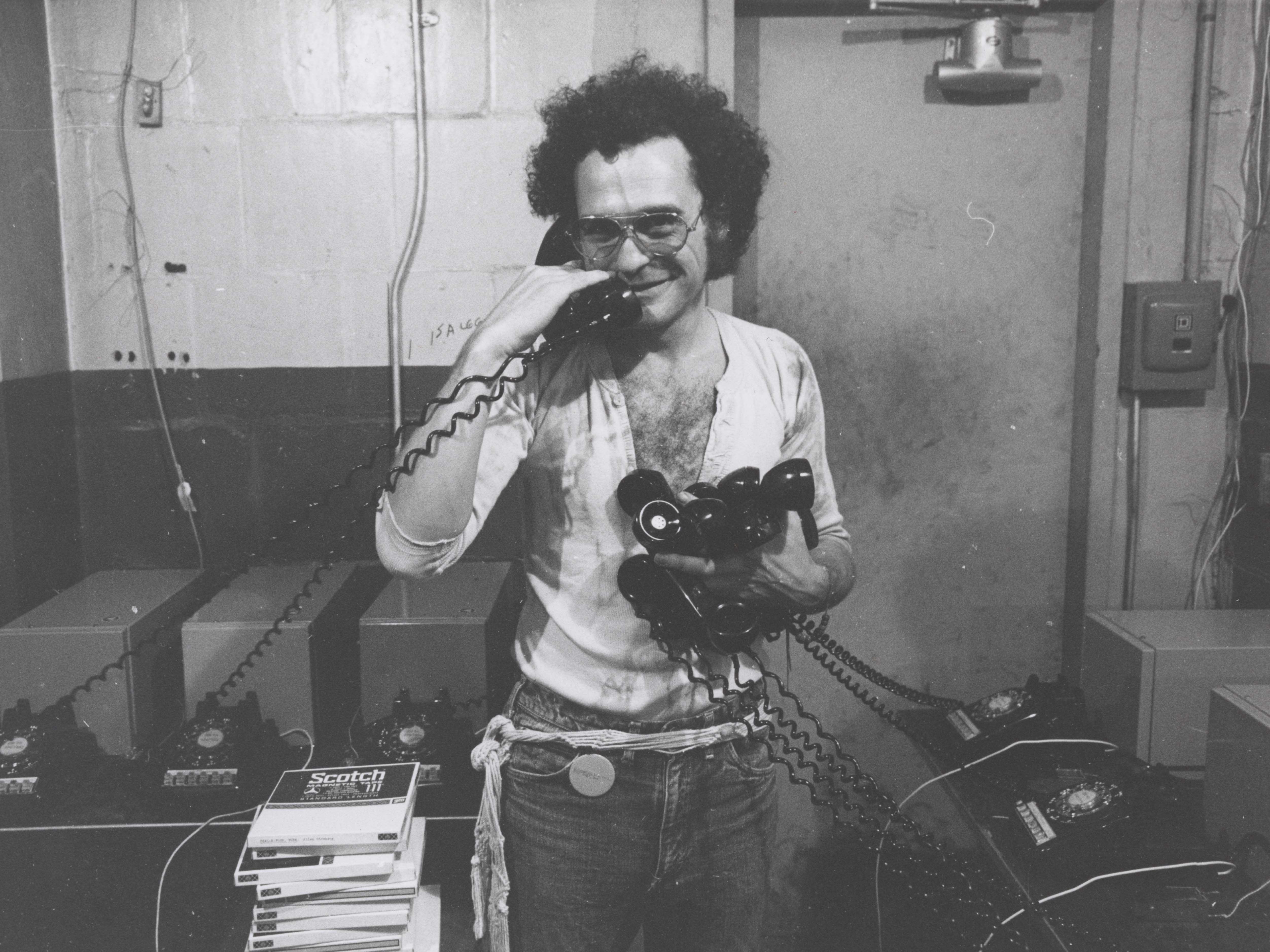
In May 1968, while on the phone, Giorno came up with the idea for Dial-A-Poem, a new way to share poetry freely with anyone who dialed in. With this project, the telephone became more than a mere communication tool: the poet’s voice came through the receiver, turning it into a small, private listening space.
He began recording poets and poems he admired, transforming his initial idea into a creative, collaborative endeavor. Technically, the project was ambitious for its time: Giorno made reel-to-reel recording, changed tracks by hand, and wired up multiple machines to a single phone line. Thanks to the help of engineers, the service officially went live in December 1968.
Dial-A-Poem was an instant hit: the phone lines were soon overwhelmed, and the project drew wide media attention. Since 1970, when it was shown at New York’s Museum of Modern Art, the work has continued to evolve, taking on new guises and moving from place to place.
#17 – Dial-A-Poem Switzerland: +41 22 539 40 91
At its core, Dial-A-Poem is a collaborative project that aims to take poetry of all kinds—from poets of all flavors—and make it accessible to anyone who wants to dial in. And right from the outset, Giorno encouraged others to take his idea and set up their own poetry hotlines.
Yet it took until 2016 for a similar service to launch in France, and it was only after Giorno’s death that the concept spread more widely, with incarnations appearing in Mexico, Brazil, Italy, Hong Kong and Thailand.
Dial-A-Poem Switzerland, the version launched here, can be reached by dialing +41 22 539 40 91. Visitors can also access the service in the dedicated phone booth at the Bains des Pâquis. Featuring texts and recordings by 30 Swiss writers working in the country’s four national languages, it highlights the diversity of Swiss literature in both its forms and creators.
So dial in and listen—poetry is just a phone call away.
Featuring poems by the following artists:
Flurina Badel (RO), Yari Bernasconi (IT), Katja Brunner (DE), Kim de l'Horizon (DE), Dorothee Elmiger (DE), Michael Fehr (DE), Heike Fiedler (DE/FR), Thomas Flahaut (FR), Baptiste Gaillard (FR), Rebecca Gisler (FR), Asa Hendry (RO), Thomas Hirschhorn (DE), Annette Hug (DE), Carmen Jaquier (FR), Kayije Kagame (FR), KT Gorique (FR), Simone Lappert (DE), Max Lobe (FR), Julien Maret (FR), Marko Miladinović & Laura Giuliberti (IT), Fatima Moumouni (DE), Bruno Pellegrino (FR), Pierrine Poget (FR), Ugo Rondinone (DE), Davide-Christelle Sanvee (FR), Elisa Shua Dusapin (FR), Marina Skalova (FR), Michelle Steinbeck (DE), Henri-Michel Yéré (FR), Ivna Žic (DE)